When fans settle into their seats at the arena or tune in to watch their favorite team, one common question arises: how long is a hockey game? Understanding hockey game length involves more than just looking at regulation time. The duration depends on several factors, including the league, overtime periods, and various stoppages that occur during play.
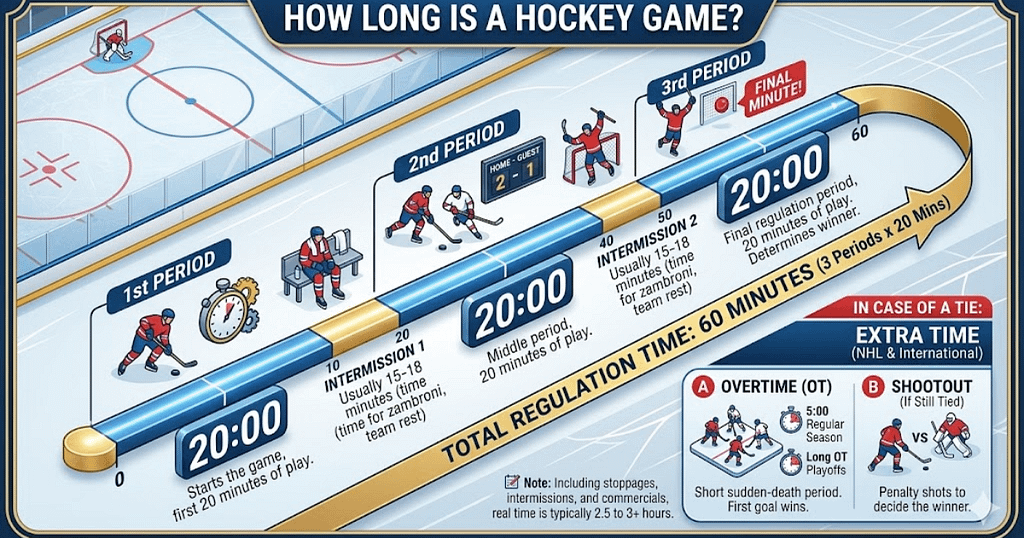
Standard Hockey Game Duration
A typical hockey game consists of three 20-minute periods, totaling 60 minutes of regulation play. However, the real time spent watching extends far beyond this due to intermissions, stoppages, and commercial breaks during NHL games.
Understanding NHL Game Length in Real Time
In the NHL, each intermission lasts approximately 17-18 minutes, adding roughly half hours to the overall experience. An average length NHL game typically runs between 2.5 to 3 hours from puck drop to the final buzzer for fans at the arena.
College Hockey and Youth Hockey Game Duration
College hockey games follow similar rules with three 20-minute periods, though college hockey may have slightly different intermission lengths depending on the league. High school hockey and youth hockey feature shorter periods to accommodate younger players.
How Long Is Overtime In Hockey?
When regulation time ends with a tied score, the game moves into extra time. The length and rules of overtime vary significantly depending on whether it’s regular-season play or playoff games in professional leagues.
NHL Regular Season Overtime Period Rules
During the NHL regular season, if no team scores during regulation, the game proceeds to a single overtime period lasting five minutes. This sudden-death overtime means the first team to score wins immediately with 3-on-3 play.
The Shootout: Breaking Ties After Overtime
If no one scores during the overtime period, the game moves to a shootout. The shootout consists of three rounds initially, with each team selecting players to take penalty shots until someone scores and breaks the tie.
NHL Playoffs: Extended Sudden-Death Overtime
However, NHL playoffs operate differently. Playoff overtime periods are full 20-minute periods of 5-on-5 sudden-death play. Games continue with additional overtime periods until a team scores, meaning playoff games can extend for hours.
Historic Overtime Games in NHL History
In NHL history, some memorable marathon games have lasted into multiple overtime periods, with legendary performances like Keith Primeau’s heroics for the Flyers against Detroit demonstrating the endurance required in playoff hockey.
Other Reasons A Hockey Game May Take Longer
Beyond regulation play and overtime, several factors contribute to extended game length. Understanding these elements helps fans plan their time at the arena or watching ice hockey from home.
Penalties and Power Play Situations
When a player commits an infraction like slashing or goaltender interference, the clock stops and the offending player serves penalty time. Minor penalties last two minutes, while major penalties require five minutes of play.
How Penalties Extend Game Duration
During these penalty situations, the team with more players on ice has a power play advantage, while the other team plays short-handed. Multiple penalties significantly extend real time, especially when infractions overlap throughout the game.
Stoppages and Breaks During Hockey Games
Ice hockey features numerous natural stoppages. The clock stops whenever the puck goes out of play, when a goal is scored, or when officials call offsides or icing. Each stoppage requires resetting play with a faceoff.
Commercial Breaks in Televised Games
Commercial breaks during televised games, particularly NHL games, add to the length. Television broadcasts schedule breaks at specific points, extending time between action. Timeouts also allow coaches to strategize during crucial moments.
Season and League Variations Affecting Duration
The time of season affects game pace and length. Early season games may move faster as teams find their rhythm, while intense playoff situations feature more physical play, more penalties, and consequently more stoppages.
Different Rules Across Hockey Leagues
Different leagues have varying rules that impact duration. College hockey games might have different rules regarding stoppages and penalties compared to the NHL. Professional leagues in other regions may follow slightly different formats.
Injuries and Equipment Issues During Play
When a player is injured, play stops immediately. Depending on the severity, medical staff may need several minutes to attend to the player. Equipment malfunctions also cause delays that extend overall game time.
Planning Your Time for Hockey Games
Understanding these factors helps hockey fans appreciate why games extend beyond the basic 60 minutes of regulation time. Each trip to watch ice hockey is a commitment of 2.5 to 3 hours on average for regular-season games.
Extended Duration in Playoff Hockey
Playoff games potentially last even longer when multiple overtime periods come into play. Fans attending playoff games should prepare for an extended sports experience, as sudden death can continue until someone scores the winning goal.
For more guides & news, you can visit our website
FAQs about How Long Is A Hockey Game
How long does a typical NHL game last?
An NHL game lasts about 2.5 to 3 hours in real time, including three 20-minute periods, two intermissions, and various stoppages throughout play.
What is the shortest possible hockey game duration?
The shortest hockey game would be 60 minutes of regulation time plus intermissions, totaling roughly 2 hours if there are minimal stoppages or penalties during play.
How long can playoff hockey games last?
Playoff games can last 4-5 hours or more when multiple overtime periods are needed, as teams play full 20-minute sudden-death periods until someone scores a goal.
Do all hockey leagues have the same game length?
No, youth hockey and high school hockey often have shorter periods than professional leagues. College hockey follows similar rules to the NHL but may vary by league.
Why do hockey games take longer than 60 minutes?
Hockey games extend beyond 60 minutes due to intermissions, commercial breaks, penalties, stoppages, timeouts, and other factors that stop the clock during play.