Gold melting point equals 1,064°C, which converts to 1,947°F and 1,337 Kelvin. This gold melting temperature represents the exact point at which solid gold transforms into liquid under standard atmospheric pressure. Scientists classify this value as a key thermal property of gold and a critical measurement in metallurgy, jewelry manufacturing, and electronics engineering.
Understanding the melting point of gold helps investors, jewelers, refiners, and engineers evaluate purity, performance, and industrial applications.
What Is Gold Melting Temperature
Melting point refers to the temperature at which a solid substance changes into liquid form. Gold melting temperature remains relatively high compared with many common metals due to strong metallic bonding and dense atomic structure.
Gold carries atomic number 79 and appears in the periodic table as a transition metal. Strong attraction between gold atoms creates a stable crystalline lattice. High thermal energy is required to break this lattice, which explains why pure gold melting point reaches 1,064°C.
This phase change of gold occurs without chemical alteration. Physical properties of gold such as density, conductivity, and corrosion resistance remain central to industrial value.
Pure Gold Melting Point vs Gold Alloys
24k gold melting point equals 1,064°C because 24 karat gold represents pure elemental gold. No additional metals interfere with atomic bonding structure.
18k gold melting temperature and 14k gold melting point differ slightly. Alloying gold with metals such as Copper or Silver reduces melting temperature because mixed atomic arrangement weakens uniform metallic bonding.
Jewelry manufacturers adjust alloy composition to control hardness, durability, and casting behavior. Gold alloy melting point therefore depends on the percentage of pure gold within the mixture.
Gold Melting Point Compared with Other Metals
Comparison strengthens understanding of gold heat resistance and industrial positioning.
- Gold melting point equals 1,064°C.
- Silver melting point equals 961.8°C.
- Copper melting temperature equals 1,085°C.
- Iron melting point equals 1,538°C.
- Platinum melting point equals 1,768°C.
Gold melting temperature stands higher than silver yet lower than iron and platinum. This balance between workability and heat resistance supports widespread industrial use.
Why Gold Has High Melting Point
Gold atomic structure plays a major role in thermal stability. The dense electron cloud surrounding the gold nucleus strengthens metallic bonding. High density of gold, approximately 19.32 grams per cubic centimeter, contributes to compact crystal lattice.
Thermal properties of gold include excellent conductivity and resistance to oxidation. Strong bonding requires significant thermal energy input before structural breakdown occurs. Resulting gold melting temperature ensures reliability in high temperature environments.
Gold chemical properties also support stability. Gold resists corrosion and oxidation even under intense heat exposure. This characteristic differentiates gold from reactive metals.
Gold Boiling Point and Phase Change
Gold boiling point equals approximately 2,970°C. Boiling point of gold far exceeds gold melting point. Melting involves transition from solid to liquid, while boiling represents transition from liquid to vapor.
Industrial refining and gold purification processes rarely approach boiling temperature because energy demand remains extremely high. Most gold casting process operations occur slightly above melting temperature to ensure smooth fluid flow.
Industrial Gold Melting Process
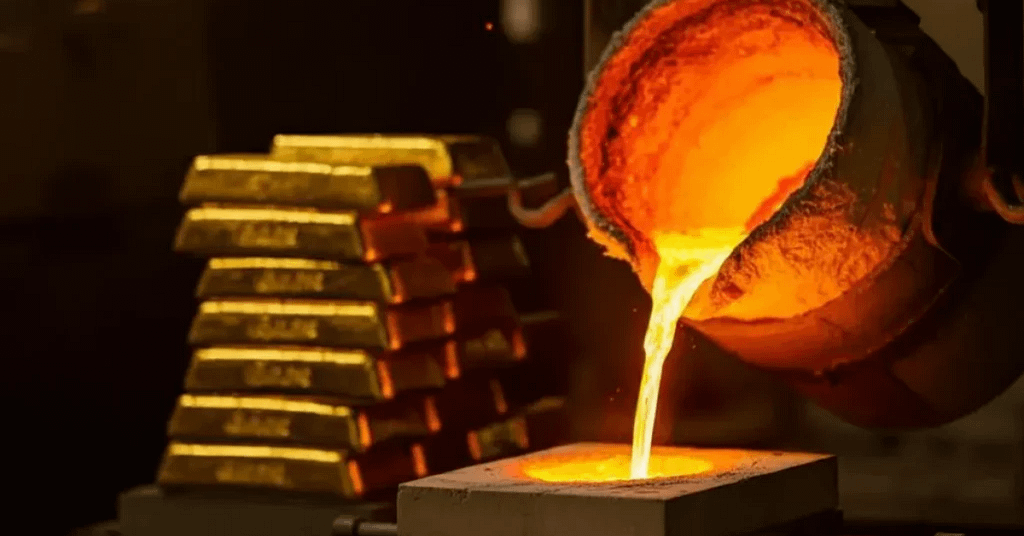
Gold melting furnace systems operate in jewelry workshops and large scale refineries. An induction furnace for gold uses an electromagnetic field to generate rapid heat. The crucible method remains common in small scale operations.
The gold casting process begins with heating metal beyond gold melting temperature. Molten gold then pours into the mold cavity. Controlled cooling restores solid crystalline structure.
Gold refining process often includes smelting gold to remove impurities. Temperature control remains critical because excessive heat may damage crucible material or alter alloy composition.
Jewelry gold melting requires precision to preserve karat purity. Temperature monitoring devices help maintain a consistent melting environment.
Gold Melting at Home and Practical Considerations
Temperature required to melt gold reaches 1,064°C, which exceeds capability of many household heat sources. Propane torch to melt gold may succeed with small quantities and proper insulation, yet safety risk remains significant.
Smelting gold at home demands heat resistant crucible, protective equipment, ventilation, and temperature measurement tools. Gold melting temperature at home without professional equipment may lead to incomplete melting or contamination.
Understanding gold melting point therefore supports safe handling and informed decision making.
Gold in Electronics and High Temperature Applications
Gold heat resistance and conductivity support extensive use in electronics. Circuit boards rely on thin gold layers for corrosion resistant connections. The aerospace industry, including NASA, integrates gold coatings in spacecraft components to reflect radiation and protect sensitive instruments.
Gold melting temperature ensures structural integrity during manufacturing processes involving soldering and thermal cycling. High temperature metals often sacrifice conductivity or corrosion resistance, yet gold balances both properties effectively.
Key Thermal and Physical Properties of Gold
- Gold melting point 1,064°C.
- Gold boiling point 2,970°C.
- Density of gold 19.32 g per cubic centimeter.
- Atomic number 79.
- Excellent electrical conductivity.
- Strong corrosion resistance.
These physical properties of gold explain enduring demand across finance, jewelry, aerospace, and electronics sectors.
Conclusion
Gold melting point equals 1,064°C, positioning gold as a high temperature yet highly workable precious metal. Pure gold melting point remains constant, while gold alloy melting point varies according to composition. Strong metallic bonding, dense atomic structure, and stable chemical behavior contribute to elevated gold melting temperature.
Precise understanding of the melting point of gold supports jewelry production, gold refining process, industrial casting, and advanced electronics manufacturing. Gold thermal properties continue to reinforce its reputation as a reliable and valuable metal within the global market.
For more guides, you can visit our website
FAQs
What temperature does 24K gold melt?
24K gold melting point equals 1,064°C or 1,947°F. Pure gold melts at this temperature under standard atmospheric pressure.
Which melts faster, gold or silver?
Silver melts faster because silver melting point equals 961.8°C, which remains lower than gold melting point of 1,064°C
Why is gold so expensive?
Gold remains expensive due to rarity, high demand in jewelry and electronics, strong corrosion resistance, and global investment value.
What is the melting point of 22 karat gold?
22 karat gold melting point ranges near 1,000°C to 1,060°C depending on alloy composition and metal mixture percentage.