Introduction
The fax machine revolutionized communication long before the internet and e-mail transformed how we share documents. Understanding when the fax machine was invented requires looking back further than most people realize—this technology has roots stretching back to the 19th century.
The device that would eventually become essential in offices across the United States, from New York to California, from Texas to Washington, had a fascinating journey from concept to widespread adoption.
Today, while traditional fax services have evolved into online faxing and free fax options available through website platforms, the fundamental concept remains unchanged: transmitting document pages from one location to another.
Whether someone needs to send a single page or multiple files to representatives in Georgia, Pennsylvania, or Puerto Rico, fax technology continues serving important communication needs.
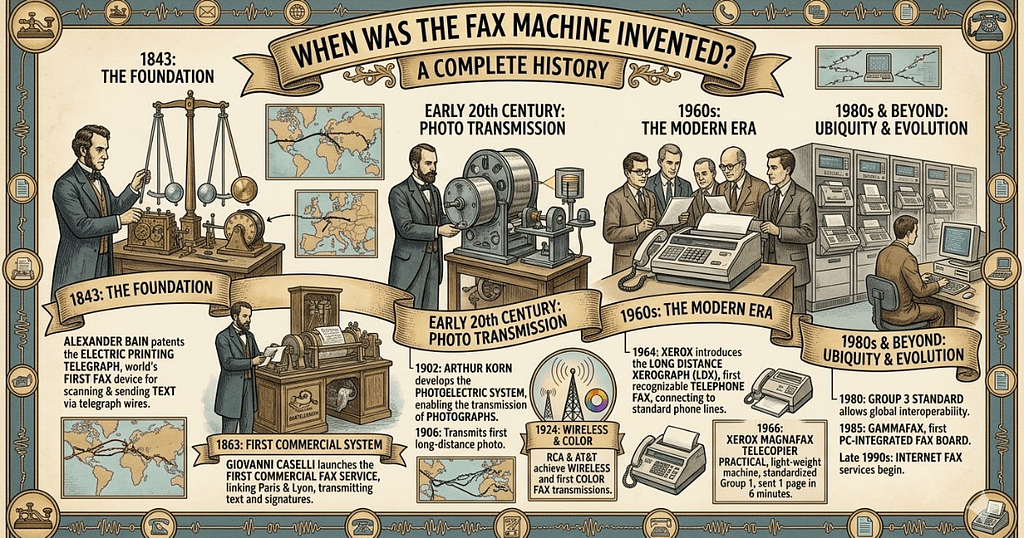
Timeline of Fax Machine History
The invention of fax technology predates many modern innovations, with its timeline revealing surprising early developments that laid groundwork for today’s faxing services.
1843: Scottish inventor Alexander Bain patents the first fax-like device, creating a system that could transmit images over wire using synchronized pendulums. This breakthrough concept established the foundation for future fax machines.
1861: Italian inventor Giovanni Caselli develops the pantelegraph, the first commercial faxing service, successfully transmitting documents between Paris and Lyon. This marked the first practical application of fax technology.
1964: Xerox introduces the Long Distance Xerography (LDX), considered the first modern fax machine, though it remained expensive and primarily used by large corporations. The fax number system becomes standardized, allowing machines to communicate more reliably.
1980s: The rise of analog faxing transforms offices throughout the United States. Businesses in Arizona, North Carolina, Tennessee, Ohio, and North Dakota adopt fax machines as standard equipment.
Governments, including those in Wisconsin, Vermont, Wyoming, and Rhode Island, integrate fax into official communications across regions from Florida Georgia Guam to Hawaii Idaho Illinois.
2000s: Internet-based fax service options emerge, allowing users to send faxes through computer systems without traditional phone line connections. Premium fax services offer enhanced features beyond free service options.
The History of the Fax Machine
The journey from concept to ubiquitous office machine spans nearly two centuries, with the fax machine evolving through numerous technological iterations before becoming the device recognized today.
Alexander Bain’s 1843 patent introduced the concept of transmitting images electrically, though his device required perfect synchronization between sending and receiving units. Giovanni Caselli’s pantelegraph, operational by 1861, achieved reliable commercial operation.
The French postal system adopted this technology, enabling businesses to transmit written message content between cities—a process remarkably similar to modern pdf file transmission.
The true breakthrough came in 1964 when Xerox’s LDX machine offered practical office faxing, though a single page could take six minutes to transmit. Standardization proved crucial for widespread adoption. Before common protocols, machines from different manufacturers couldn’t communicate.
The 1968 standards ensured any fax machine could send documents to anyone with compatible equipment, regardless of manufacturer.
The Rise of Analog Faxing
The 1980s witnessed explosive growth in fax machine adoption as analog technology matured and costs decreased. What began as premium equipment costing thousands became affordable for businesses throughout American Samoa, Arizona Arkansas California, Colorado Connecticut Delaware, and beyond.
Analog faxing works through phone line connections, converting document images into audio tones transmitted over traditional telephone networks. When someone sends a fax, the machine scans each page, converts the visual information into electrical signals, then transmits these signals through the phone number connection. The receiving machine decodes these tones back into the original document image.
By the late 1980s, businesses across Indiana Iowa, Louisiana Maine Maryland, and throughout the Northern Mariana Islands adopted fax machines as essential equipment. A governor in one state could communicate quickly with officials in Oklahoma Oregon Pennsylvania or South Carolina South Dakota Tennessee Texas.
Cover page conventions developed, standardizing information like recipient name, sender details, page count, and confirmation instructions. The familiar “thank you” message became business communication standard practice.
Fax technology reached every corner of the nation, from New Hampshire to New Jersey, from Utah Vermont Virgin Virginia Wisconsin to the most remote locations. Anyone with a machine and phone line could participate in this communication network.
Representatives conducting business across area code boundaries found fax eliminated geographic barriers. Most-faxed representatives in busy offices dealt with constant transmissions. Yet despite limitations like busy signals and paper jams, fax remained dominant through the 1990s.
The Impact of Fax Today
While e-mail and internet-based communication have transformed how people share documents, fax technology persists, adapting to modern digital environments while retaining relevance in specific sectors.
Healthcare providers transmit patient information via fax for regulatory compliance. Legal professionals rely on fax for court filings and contracts. Government agencies, from local offices in New York to federal departments in Washington, maintain fax capabilities for official correspondence.
The evolution to online faxing represents the most significant modern development. Services now allow users to send faxes through computer systems without physical machines.
Users upload a pdf file, image files in formats like png, or documents created in Microsoft Word, rtf, xls, or ppt formats. The service transmits them to the recipient’s fax number, delivering a confirmation via e-mail message to the sender’s e-mail address.
Free fax services emerged, offering limited page transmission per day at no cost—a wonderful service for occasional users. Premium services provide unlimited faxing and multiple files transmission. Users should check their spam folder for confirmation messages.
Major website platforms now integrate fax capabilities, allowing anyone to send free faxes without specialized equipment. These useful sites democratized access to fax technology.
The scanner revolution complemented this evolution. Users scan physical documents, creating digital file formats suitable for online transmission. Whether sending to a business in Georgia, Wisconsin, Texas, or Puerto Rico, the process requires just minutes using a computer and internet connection.
Modern fax service options serve global users, supporting transmission to virtually any area code worldwide.
Thanks to technological adaptation, fax survived when many predicted its demise. The list of industries depending on fax includes healthcare, legal services, government, real estate, and financial services—sectors where document security and compliance remain paramount.
For more guides & news, you can visit our website
FAQs
How did the 1843 fax machine work?
Alexander Bain’s 1843 device used synchronized pendulums and a stylus to scan metal type, converting physical documents into electrical signals transmitted over telegraph wires to reproduce images remotely.
When did fax machines start?
Fax technology started in 1843 with Alexander Bain’s patent. Commercial faxing began in 1861 with Giovanni Caselli’s pantelegraph. Modern fax machines emerged in 1964 with Xerox’s LDX system.
Did they have fax machines in the 70s?
Yes, fax machines existed in the 1970s but remained expensive and primarily used by large corporations. Widespread adoption occurred in the 1980s when costs decreased and standardization improved.
What does fax mean Gen Z?
To Gen Z, “fax” is slang meaning “facts” or “truth,” often used to agree with someone. It’s unrelated to the fax machine technology, representing how language evolves across generations.